

Most program leaders who write a self-study alone do it for one reason: it feels faster. It rarely is, and the cost goes well beyond a few extra hours. This guide covers what reviewers notice when one person holds the pen, what a right-sized team looks like, and how to build one without adding yet another committee to everyone’s calendar.
Why the “Hero Model” Sets Off Alarm Bells for Reviewers
Peer reviewers aren’t distant regulators checking boxes. They’re experienced academic colleagues, trained to test whether your program’s quality is real and shared. Their working rule is simple: trust, but verify.
When a review team opens a self-study that one person wrote, they tend to notice quickly, and a single author usually produces a more fragile submission. Here’s why.
1. You lose triangulation. Reviewers check your claims by making sure three things line up independently: the narrative, the evidence, and what people tell them in interviews. If faculty can’t describe the assessment results written under their names, the gap shows within minutes, and it makes reviewers wonder about the rest of the report.
2. You get a blind spot. Every author suffers from the curse of internal knowledge. When one person holds the pen, shorthand goes unexplained and evidence gaps stay invisible. You know what you meant. Reviewers only know what you wrote.
3. You signal fragile sustainability. Accreditation expects quality assurance to be shared and ongoing. A self-study written in a silo suggests assessment is one person’s compliance chore rather than a faculty habit, and reviewers will wonder what happens to the program if that person leaves.
A solo submission doesn’t show extraordinary dedication. It shows where the program is vulnerable.
The Personal Toll: When the Cape Weighs Too Much
The professional risk is real, and so is the personal cost.
A self-study asks you to write extensive narrative, curate several years of student learning data, and keep every artifact straight, all on top of a full teaching and administrative load. Late nights cross-referencing syllabi and weekend hunts for missing committee minutes become routine. After a few months, that pace turns into exhaustion and burnout, and it spills into family life.
There’s a quieter cost too. The leader who does everything becomes the only person who understands the evidence, so every answer in the final weeks has to come from one tired person.
Accreditation leadership should be a sustainable professional milestone, not an ordeal. A structured group spreads the work, protects morale, and lets you walk into the site visit feeling calm and prepared.
Building a Right-Sized Team: Structure Over Volume
You don’t need a big committee that slows every decision. A lean group built around five functions will do the job. In a small program, one person can hold more than one role. What matters is that each function has a named owner.
| Role | What they own | Typical time ask | What they hand you |
|---|---|---|---|
| Disciplinary Faculty | Curriculum design, learning outcomes, authentic improvement stories | A few hours per term, in defined bursts | Short, specific drafts tied to assigned standards |
| Evidence Steward | Collecting artifacts, file naming, version control, removing student personal information | Steady, light, ongoing | A clean, indexed evidence library |
| Data Lead | Retention, graduation, and longitudinal outcome data and what it means | Concentrated around each data pull | Charts, tables, and plain-language interpretation |
| Narrative Editor | One consistent voice, terminology, and cross-references across standards | Heavy in the final weeks | A cohesive, readable report |
| Internal Authority | Resources, early visibility into weaknesses, institutional backing | A short briefing at regular intervals | Decisions, funding, and cover when tradeoffs arise |
Disciplinary Faculty: the architects of student learning
Faculty belong at the center of the self-study. They explain curriculum design, put clinical or professional benchmarks in context, and show real continuous improvement. Skip the vague request for “help.” Give each person a specific standard cluster or a micro-deliverable, like three targeted paragraphs on capstone performance.
Evidence Steward: ending the documentation scramble
Disorganized documentation causes more friction than almost anything else. Ask a colleague or administrator to run artifact collection, set file-naming conventions, redact student personal information, and keep version control. Start in the first week, not the last.
Data Lead: proof of impact, not proof of activity
You shouldn’t have to decipher retention trends, graduation rates, and longitudinal rubric scores alone. Partner with a colleague who’s comfortable with quantitative reporting, or with a liaison from institutional research. That partnership keeps your evidence focused on results instead of a list of things the program did.
Narrative Editor: one voice
Self-studies often read like a patchwork of voices. An objective editor reads every response start to finish, aligns terminology, and checks that cross-references between standards are clean. Pick someone who wasn’t a primary author so they read it the way a reviewer will.
Internal Authority: your chair, dean, or provost
Bring your chair, dean, or provost in early, and brief them on likely vulnerabilities before reviewers find them. A leader who hears about a weakness six months out can fund a fix. One who hears a week before the site visit can only react.
How the Team Fits Together
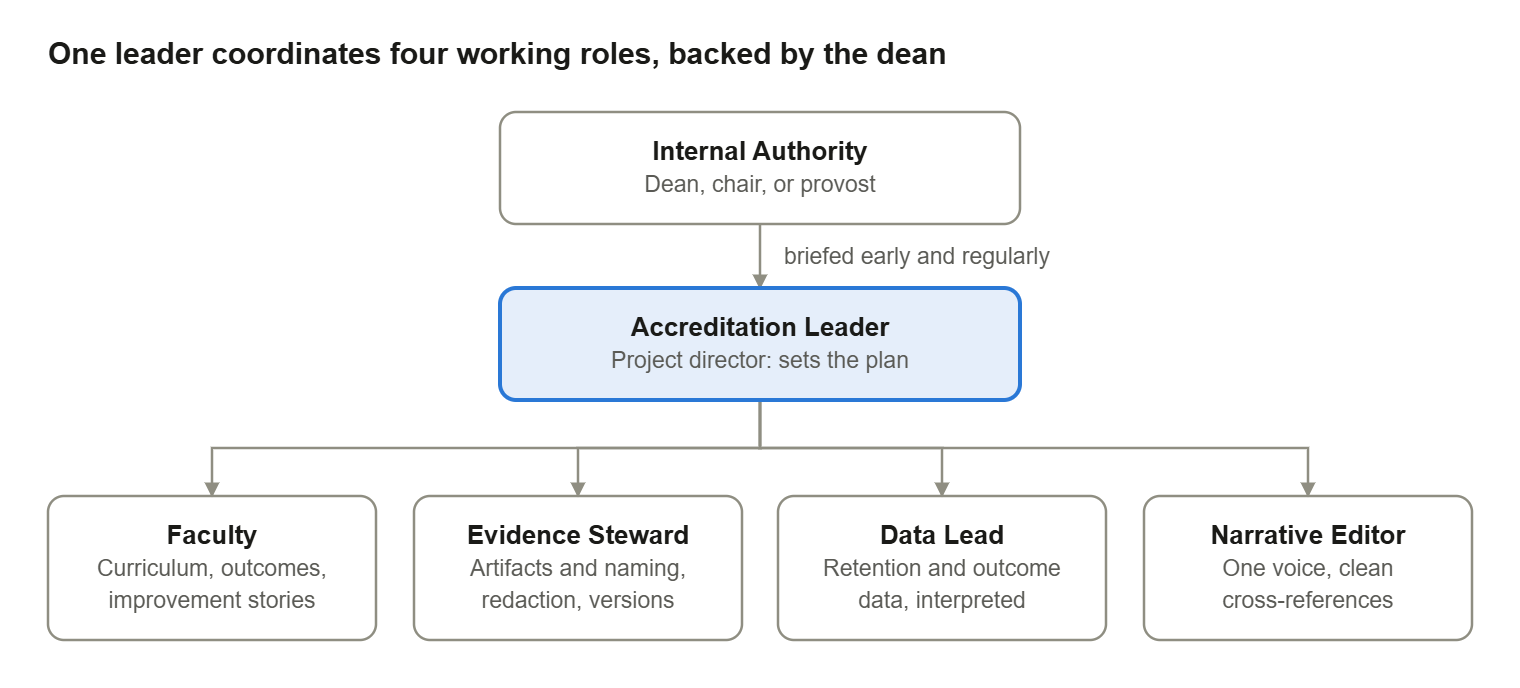
The leader sets the plan and coordinates. Each of the four working roles (faculty, evidence steward, data lead, and narrative editor) owns a distinct piece of the submission, and the dean, chair, or provost stays in the loop so resources and decisions show up before they’re urgent.
How to Recruit Faculty Without Adding Dread
The most common reason leaders go solo is that asking colleagues feels like an imposition. The fix is to make the ask small, specific, and time-boxed. People say yes to a clear 90-minute task much more readily than to an open-ended commitment.
Run a 45-minute kickoff
One meeting, one agenda, one outcome: everyone leaves knowing exactly what they own.
- Start with why (5 minutes). Explain what accreditation protects for students and for the program’s standing, and what reviewers will test.
- Show the map (10 minutes). Put the standards on one page, grouped into clusters, with the assignments blank.
- Assign clusters (15 minutes). Let faculty claim the standards closest to their teaching, and fill any gaps yourself.
- Define the deliverable (10 minutes). Show one finished example so nobody has to guess at length or tone.
- Set the calendar (5 minutes). Confirm due dates and the next check-in before anyone leaves.
Make the ask concrete
Here’s the difference between two ways of asking.
Vague: “Can you help me with the accreditation report this year?”
Specific: “Can you draft about 300 words on how the capstone rubric results led to the changes we made in the research methods course? I’ll send you the last three years of scores. It’s due March 15, and I’ll sit down with you that week to read it over.”
The second version tells the person what to write, what they’ll get, when it’s due, and how much support to expect.
Work Backward From Submission
Accreditation works as a cycle, not a deadline: Build, Organize, Review, Submit, Maintain. This timeline works backward from your submission date. Adjust the lead times to your accreditor’s calendar, your program size, and whether a site visit follows.
| Phase | When (before submission) | Main work | Who leads |
|---|---|---|---|
| Build | 12 to 18 months | Form the team, hold the kickoff, assign standard clusters, brief the dean | Program leader |
| Organize | 9 to 12 months | Set up the evidence library and naming rules, pull multi-year data, find gaps early | Evidence Steward, Data Lead |
| Draft | 5 to 9 months | Faculty write micro-deliverables, leader tracks progress, close evidence gaps | Disciplinary Faculty |
| Review | 2 to 5 months | Narrative Editor unifies the voice, an outside colleague reads as a reviewer, cross-references are checked | Narrative Editor |
| Submit | Final weeks | Final read, accuracy check, sign-off from the Internal Authority | Program leader, Internal Authority |
| Maintain | After submission, ongoing | Keep collecting evidence each term, log improvements as they happen, review annually | Whole team |
Two habits make this work. First, hold a short standing check-in, even 20 minutes every two weeks, so slipped deadlines surface early. Second, close gaps as soon as you find them. A gap found nine months out is a project. The same gap found three weeks out is a crisis.
Self-Check: Is Your Program Caught in the Solo Trap?
Tick each statement that’s true today. If three or more are unticked, it’s probably time to widen the circle.
☐ At least three people besides me have written part of the self-study.
☐ Every standard has a named owner other than me.
☐ One person is responsible for the evidence library, and it has a naming convention.
☐ Someone outside my own program or role has read the draft as a reviewer would.
☐ Our data comes from, or has been checked by, someone with reporting expertise.
☐ My dean or chair has been briefed on our likely weak spots this year.
☐ Faculty could explain our key outcomes data without looking at notes.
☐ If I left tomorrow, someone else could find any artifact and continue the work.
For Deans and Chairs: Five Ways to Back Your Program Leader
If you’re forwarding this to a dean, provost, or chair, this section is for them. A program leader can’t build a shared process alone, and the institution has to make it possible.
- Protect time. Recognize accreditation work in workload or release time, especially for the leader and the Evidence Steward. Unrecognized work is the first thing to slip.
- Open the data. Make sure the program has early, easy access to institutional research support. Late or incomplete data is a major cause of last-minute rework.
- Ask for the weak spots early. Invite a candid briefing at least a year out. Programs that can name their weaknesses and show a plan are in a stronger position than programs that hide them.
- Assign a reader. Ask someone outside the program to read the draft the way a reviewer would. A fresh pair of eyes catches what insiders can’t.
- Make participation count. Faculty contributions to accreditation should be visible in annual reviews. When the work is valued, the ask gets a lot easier.
A program with a healthy, shared process is also easier to lead the next year, and the year after.
The Takeaway: Accreditation Is a Cycle, Not a Crisis
Accreditation works best as an ongoing rhythm: Build, Organize, Review, Submit, Maintain. Leaders who step away from the hero model protect their time, keep morale up, and deliver a self-study that holds up under outside review. Just as important, they leave behind a program culture that doesn’t depend on any one person.
You don’t have to carry the whole thing. Start this week with one small step: name an Evidence Steward, or put a 45-minute kickoff on the calendar.
Know a program leader or dean heading into a review cycle? Forward them this guide. It could save them a lot of late nights.